
Posted on: October 27, 2026
In a recent blog post, we showed that metro Atlanta’s population growth has slowed but that the slowdown is part of a nationwide trend among large urban areas. How does the picture look for employment in our region?
To answer this question, we turn to data from the Bureau of Labor Statistics– specifically the State and Area Employment, Hours and Earnings (aka SM) series data, which is based on a survey of establishments in every industry except for agriculture.
Figure 1 presents total employment for the Atlanta MSA from January, 2012[1] through the present[2], in thousands of jobs.
Figure 1: Total Employment in Metro Atlanta, January 2012-September 2026
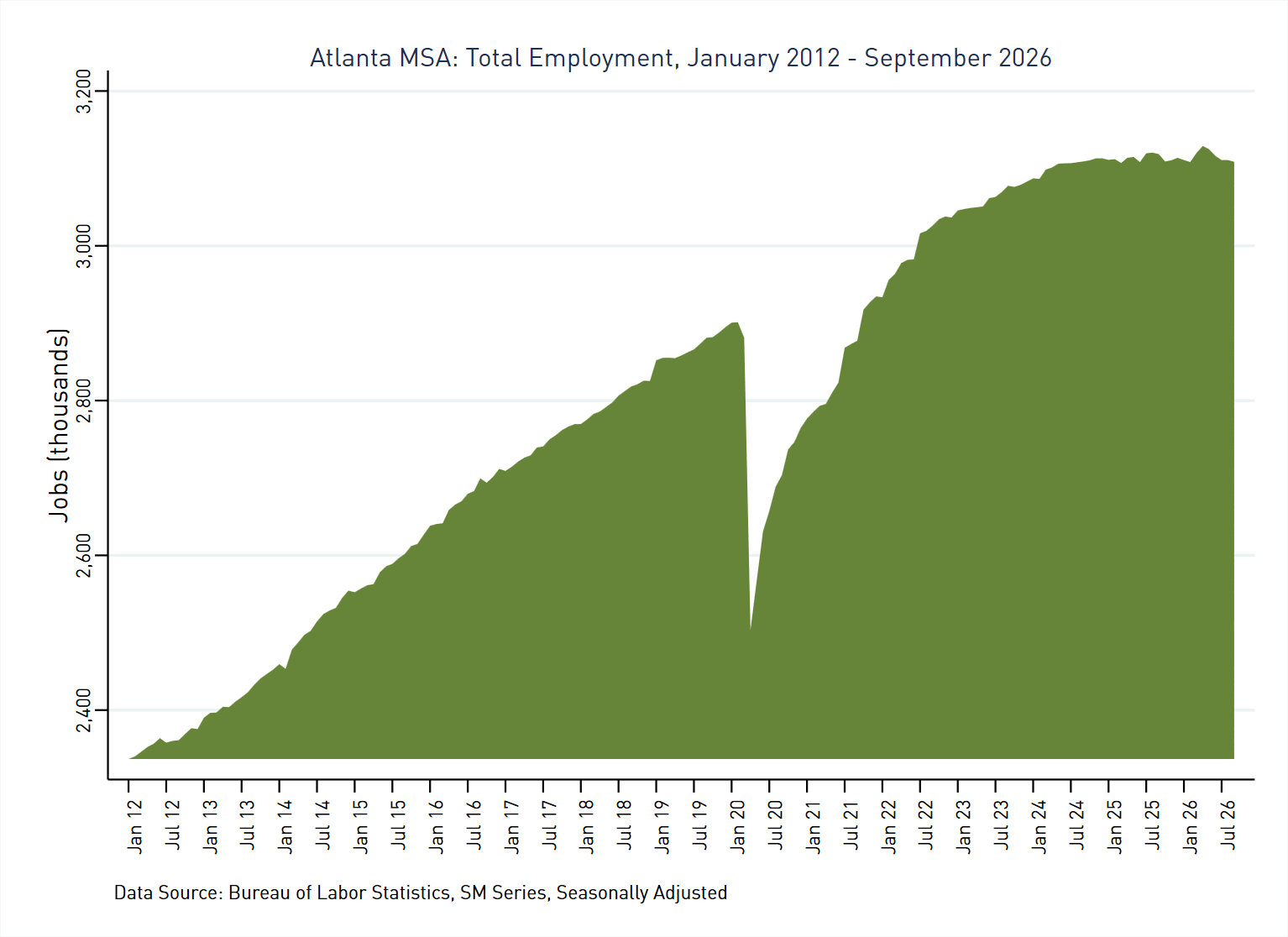
This graph shows that jobs in metro Atlanta grew steadily– almost in a straight line– as the economy recovered from the Great Recession up until the COVID-19 pandemic triggered a sharp decline in employment in the spring of 2020. Over the year that followed, jobs recovered to their pre-pandemic levels. They then continued along the same trajectory as in the 2010s, surpassing the 3 million mark in July of 2022, until eventually flattening in 2024.
Figure 2 takes a closer look at the last five years, and focuses on percent change year-over-year[3] rather than on the gross number of jobs.
Figure 2: Year over Year Job Change in Metro Atlanta, September 2021-September 2026
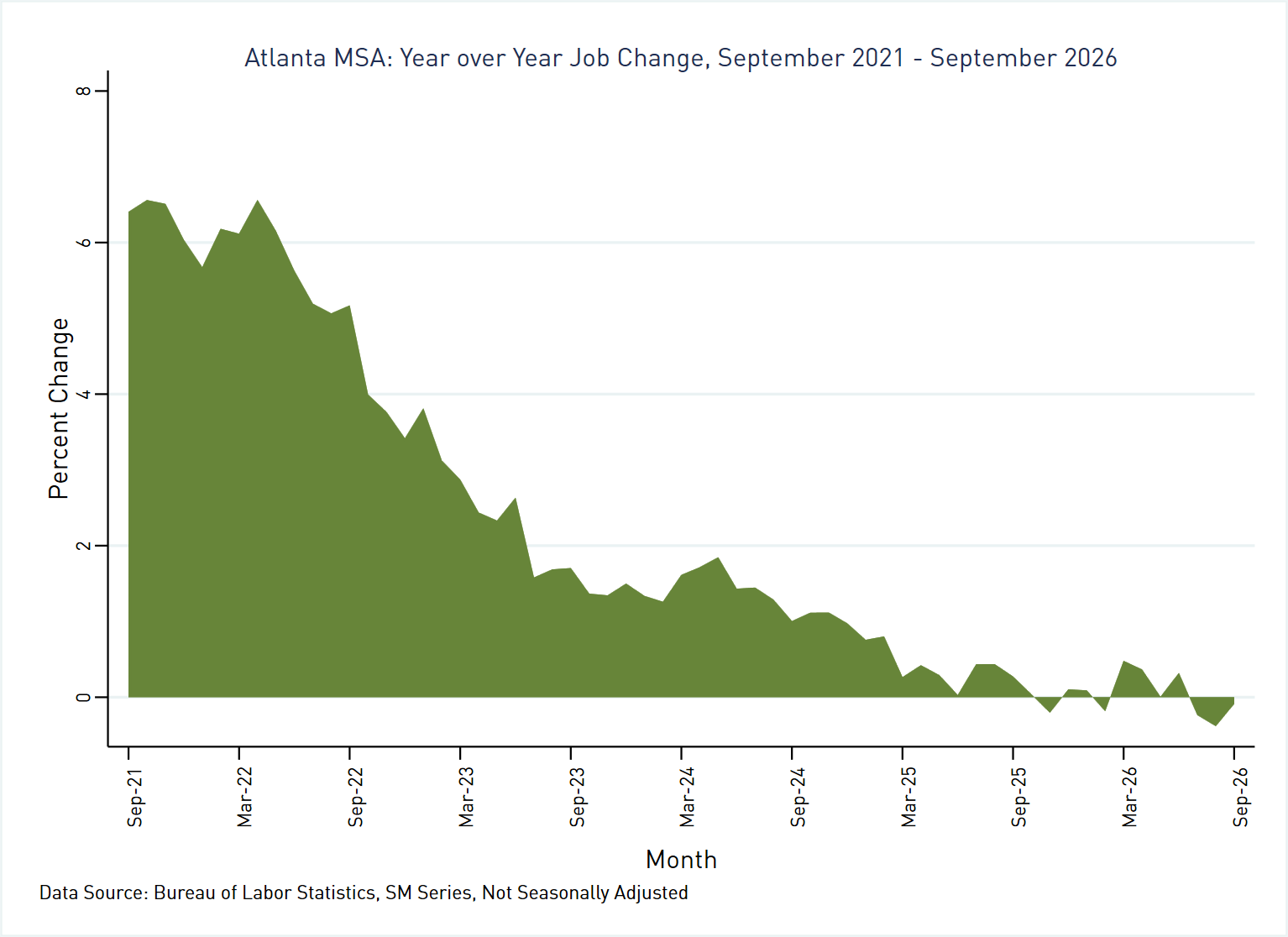
We see that growth was a robust 6% year-over-year coming out of the pandemic, then declined to around 1% for most of 2025. For most of 2025 and 2026, the year-over-year change has hovered around zero.
Has Atlanta lost its mojo? Not really– this pattern follows the nationwide trend. Figure 3 compares year-over-year employment change for the Atlanta MSA with that for the nation as a whole.
Figure 3: Comparing Year over Year Job Change in Metro Atlanta and the Nation, September 2021-September 2026
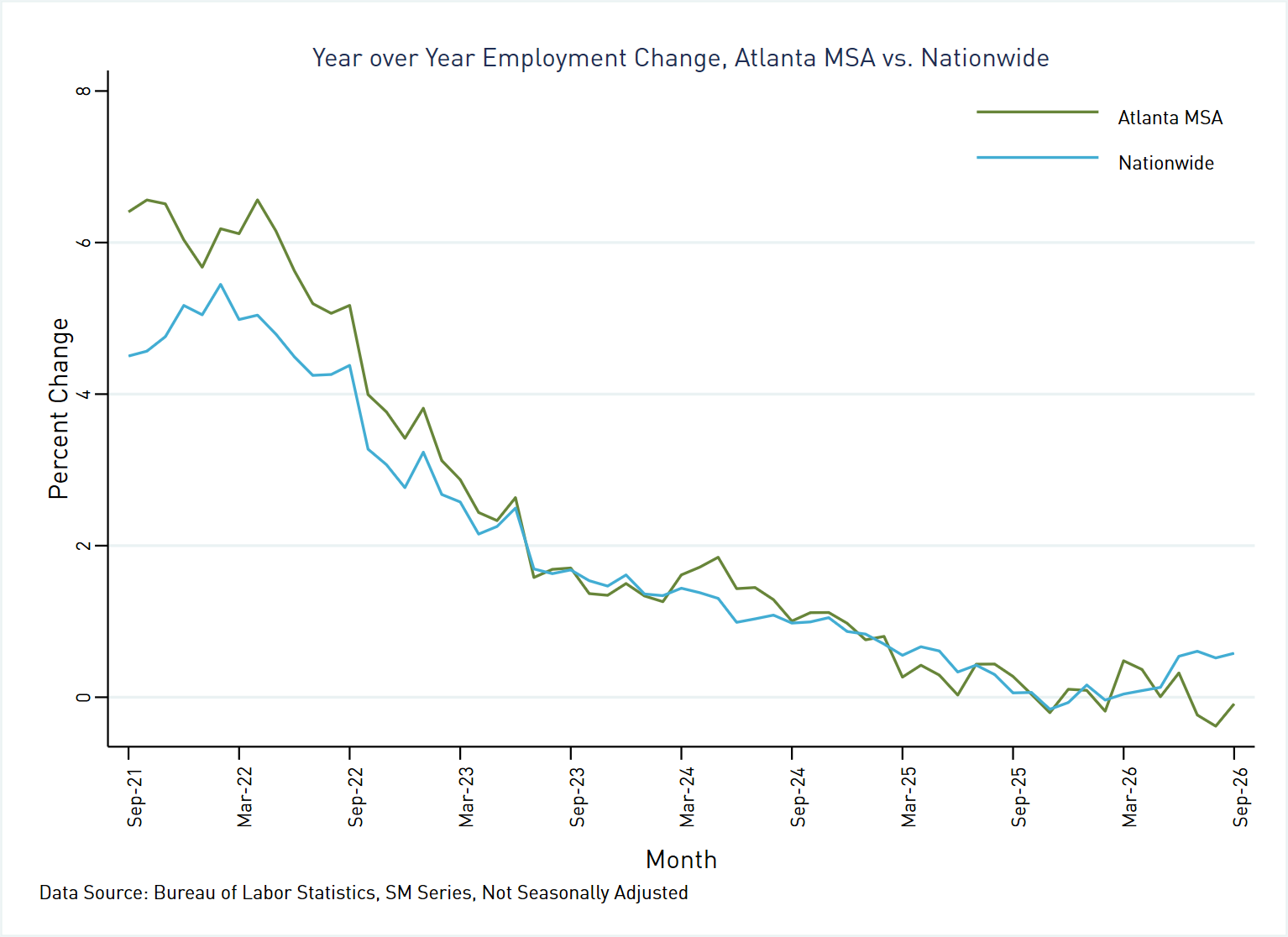
As this graph demonstrates, Atlanta’s pattern has closely mirrored that of the nation. Atlanta’s job growth was stronger than the nation as a whole coming immediately out of the pandemic; it tracked closely with the national trend for most of 2023 through early 2026, and has been a bit weaker than the nation as a whole in just the past few months.
Do any industries in Atlanta stand out particularly either for strong or weak growth? We’ll take that up in a future post.
Notes:
[1] The SM series extends back to January, 1990 and does not include unincorporated nonemployer firms.
[2] Note that the September, 2026 number is preliminary and subject to revision in a subsequent release of the data.
[3] These data compare the number of jobs in a given month with the same month one year prior. For example, the Atlanta MSA had 3,048.9 thousand jobs in March, 2023 and 3,098.5 thousand in March, 2024, an increase in 49.6 thousand jobs or about 1.6% year-over-year increase. Because we are comparing a given month with the same month the previous year, there is no need to adjust for seasonality.