Home > News Center > Working Full-Time, Living Nowhere: A Q&A With Writer Brian Goldstone About Metro Atlanta’s ‘Hidden Homeless’
News Center
Working Full-Time, Living Nowhere: A Q&A With Writer Brian Goldstone About Metro Atlanta’s ‘Hidden Homeless’
Atlanta — May 01, 2026
Writer Brian Goldstone couldn’t shake the question: Why are so many working people facing such difficulty finding safe, affordable, and stable housing?
He began talking to people near his home in metro Atlanta about their struggles. They worked full-time jobs yet were living out of their cars, on friends’ couches, or, increasingly, in run-down, extended-stay hotels.
Goldstone chronicled the myriad challenges of five metro Atlanta families in his Pulitzer Prize-winning 2025 book, There is No Place for Us: Working and Homeless in America.
The book was borne “from a conviction that before we can fix this crisis, we first have to feel this crisis,” he told about 200 leaders who attended ARC’s Regional Housing Summit on April 30. “We need to know what it feels like for parents, for their kids, when the basic security of a home is always just out of reach.”
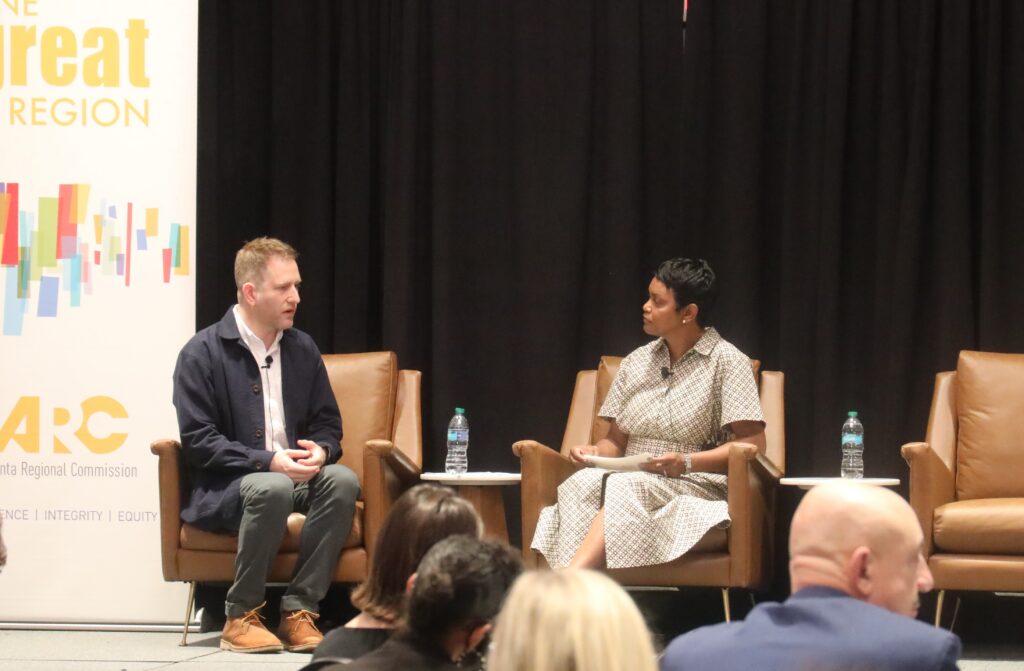
After his keynote address, Goldstone sat down with ARC Executive Director & CEO Anna Roach for conversation about his work, and what metro Atlanta leaders can do to foster change.
The following Q&A has been edited for length and clarity.
Anna Roach: Brian, your book highlights many of the challenges that brought us together for this summit. You hold up a mirror to our region, and it’s clear: something – make that, many things – need to change. I’ll start this conversation by taking a step back. What compelled you to write There is No Place for Us? And how did you choose Atlanta?
Brian Goldstone: This gathering is welcoming the mirror, and I can’t tell you how meaningful it is, because there are so many cities and regions that would prefer to just ignore it, prefer to look away.
As an anthropologist and then a journalist, I had been wanting to write and report something closer to home. My wife, Elaine, at the time was working at Mercy Care as a nurse practitioner. And we share a car, so every day I would pick her up and we would debrief our days. She started to tell me about this trend that she was noticing among her patients.
Her patients – home health and daycare workers, people driving for Uber or Lyft, or working in Amazon warehouses – were finishing their shifts and they weren’t going to an apartment. They were homeless. They were sleeping in their cars. They were doubled up with others. And a great many of them were living in these extended stay hotels.
I was stunned, honestly. Like many people, I had this assumption that work is an exit from homelessness. I began to ask, How is it that these two words (work and homelessness) go together?
And as I began to investigate, I saw how pervasive this is. It’s far from some bizarre anomaly that my wife was witnessing at her job. It was representative of an immense and growing trend around the country, albeit one that was tragically underreported and unacknowledged.
Anna: It’s not lost on me the amount of detail you were able to capture from those families is part of what makes the story so compelling. Talk to us about how you decided to embed with these families, and how you gained the trust necessary to tell their stories.
Brian: I knew that if this book was going to mean anything, it would be because readers were forced to be plunged into these families’ journeys. As I said before, I really believe that before we can fix this, we have to feel it. We have to feel it in a visceral way.
And so from the very beginning, it felt important to me to establish this almost as a collaborative project, as something that (the families and I) were both engaged in figuring out, often in very messy and improvised ways. How can we show the reality of this? How can we show the world, you know, these moments at 1 a.m. when you’re calling me to cry? Because it feels like, no matter how hard you try, at every turn, there are just these entire systems militating actively against your stability.
Trust was indispensable. I mean, trust was everything here. I told the families going into this that that at the end of this process, that I would sit down with them and we would go over every part of what was included in their stories, not only to make sure it was actual, but to make sure that they were consented fully to what was depicted. To the five families’ credit, they didn’t ask for one thing to be taken out.
Anna: You write about the ‘hidden homeless,’ which is a term I wasn’t aware of. It’s become part of my vocabulary now, so thank you for that. Arguing that a large part of the nation’s homeless population, as we know, is effectively invisible is something we’re well aware of. But tell us from your research why is that the case, and what are some of the consequences, intended or not, of that hidden homeless population?
Brian: Yeah, you know, at so many points in the process of writing this book, I’ve had to discipline my own language. I used to catch myself saying, oh, such and such number of people this year fell into homelessness. No, and they were not falling. They were being pushed. In the same way, I’ve started to use the term invisible homeless or hidden homeless.
This invisibility has been produced, and it is part of what I discovered is a concerted effort in this country. Beginning in the 1980s, when mass homelessness first began to erupt around the country, many of our political leaders realized that the narrative needed to be controlled, that the lens needed to be narrowed, and the focus needed to be adjusted in such a way that it would be sort of distorted. Because otherwise, the public might connect the dots between, on the one hand, the decimation of the social safety net, that was happening at that time: The gutting of low income housing assistance, the gutting of support for public housing, and on and on
By the end of the ’80s, CBS News and the New York Times conducted a poll, asking people at random, what causes homelessness? The number one answer was psychological problems. The second largest answer was a refusal to work. Not a single person mentioned housing. And, you know, never mind the fact that even at that point, when that survey was conducted, the fastest growing segment of the homeless population in this country were children under the age of six. So, from the very beginning, that invisibility has been actively produced.
I think we can understand, you know, if Americans saw both the true scale and the true causes of homelessness, it would force many people, not only to vote differently, but to ask very hard questions about what constitutes a strong economy in America. If a strong economy can coincide with all of this deprivation, what does that say about that economy? What does it say about America?
And just in case you get nothing else from this conversation, the reason why homelessness happens is because of a growing gap between what it costs to have a place to live and what you bring in with your income.
Anna: This makes me think about the nexus between the problems you defined and what we trying address, which is housing, and other issues like our inability to achieve economical mobility for the poor. Well, all of the symptoms of the things that cause homelessness are contributing factors to that as well.
Brian: That’s right. It’s so important that we see everything as being connected. Although economists may slice up our lives into housing over here, and childcare over here, and healthcare over here, it’s all intimately interwoven. And if you pull one thread the whole thing unravels. So, housing costs may go down if we build more units at 60% AMI, but healthcare costs may go up. It’s all intimately connected. And that’s why this term affordability is, in some ways, more helpful than just focusing narrowly on housing per se.
Anna: Shifting gears just slightly. I want to make sure we address here whose problem this is. You talk about housing being a crisis not just of the poor but of the middle class. Tell us more about that.
Brian: I mean, it’s a crisis for all of us to worry about. One of the horrifying truths about the term working homeless is that the line separating us from them becomes way more permeable than we would like to acknowledge. That many of us, you know, can be one medical emergency, one rent hike, one lapsed month of child care, whatever it is, away from losing our housing and joining the ranks of the newly homeless.
That term is a way of sort of reminding all of us that we are all much closer to becoming homeless than we are to, for instance, joining Elon Musk and his billionaire friends. There’s a kind of solidarity that naturally, organically exists once we use the term working poor, working homeless, because that is a growing segment of the U.S. population.
This is not just a problem in Atlanta. It’s as much a national issue, a Charlotte issue, Chicago, Miami, on and on. It’s a crisis for all of us who live in cities whose success, whose growth, whose revitalization, whose transformation of urban space is coming at the expense of, not those who are on the fringes of those cities, not those who are on the fringes of our society, but even more perversely, those whose bodies, whose work, whose labor, is powering that growth. These are our neighbors. These are the people who are making our lives possible.
Something has got to give. Like, none of this will be possible any longer if we don’t act quickly. And by the way, like, another thin, the term working homeless does is it says that we need to stop thinking about homelessness in terms of empathy or compassion at best, or at worst, vilification, criminalization, banishment. We need to be thinking of it, not in terms of charity, but in terms of justice and injustice.
Anna: OK, last question. What kinds of policy adjustments do we need to advocate for in order to move the needle on housing?
Brian: I hesitate to use my remaining time rehearsing policies that many of you are already intimately familiar with, things like preserving our stock of naturally occurring, affordable housing. Preservation is not a very sexy thing to talk about. It’s much sexier to talk about abundance and building and cutting the red tape.
But we need to preserve what is already there, because as many of you know, it’s way more feasible and way cheaper to preserve what’s already there than to build what isn’t there yet.
One practical consequence of gentrification and revitalization is that we’re seeing these predatory application fees. If you log into housing apps, you find apartments down the road that are saying in order to apply here, you need to pay not only a $90 application fee that’s non-refundable, but also a $250 administrative fee, also non-refundable, even if you’re rejected.
Natalia in the book says, ‘How are they getting away with this?’ And she answers her own question: Because they can, because nobody is stopping them. That is a practical manifestation of how the revitalization or what real estate agents love to call a hot rental market.
So there’s stuff like that. But I would, I would ask all of us to become newly enraged, not just newly compassionate and empathetic, that we have not just allowed, but forced, so many of our neighbors, so many of the people taking care of our kids our elders, to endure this kind of precarity and hardship. It is so utterly unnecessary.
ARC’s Executive Director Anna Roach, right, talks with writer Brian Goldstone about his work to highlight the working homeless