
Flint River Gateway Trails
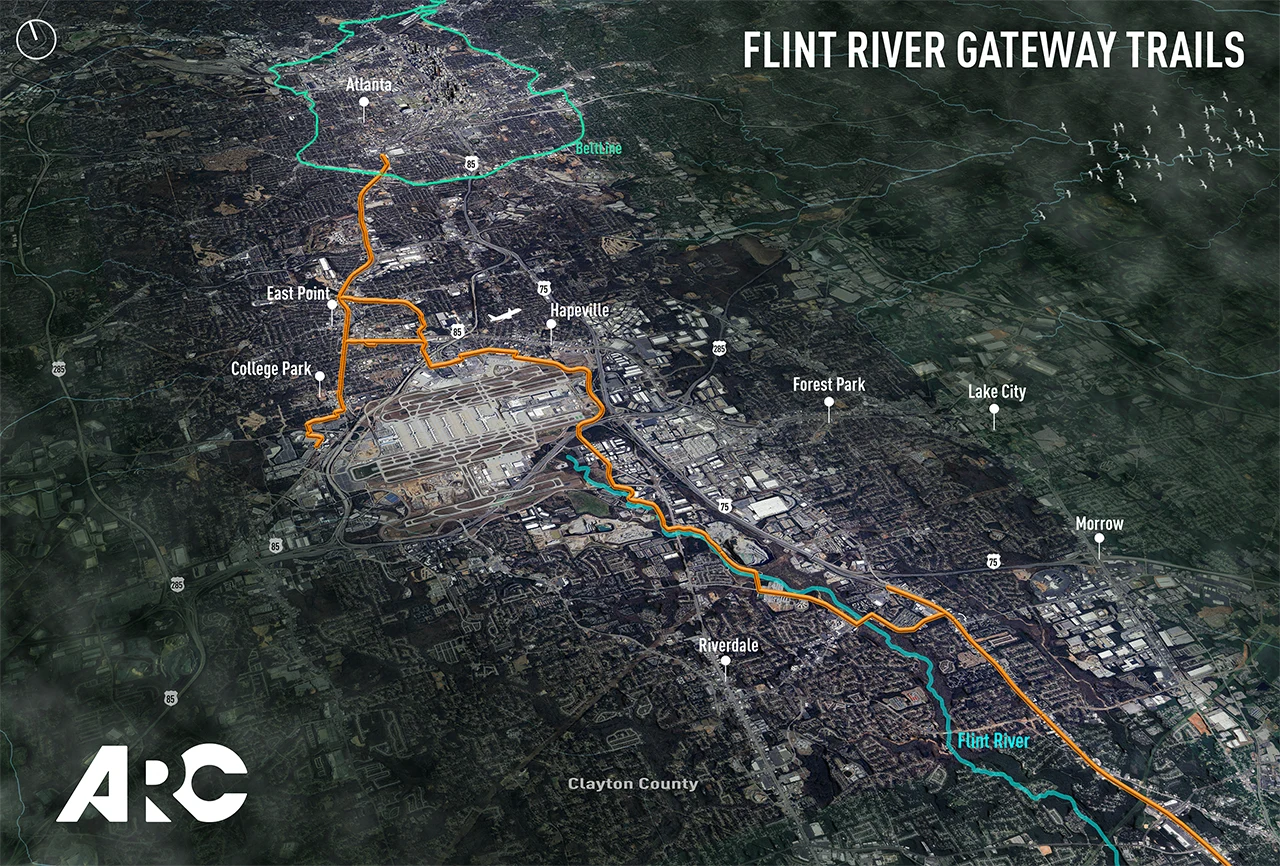
ARC is working with local governments in the South Metro Atlanta area to plan and develop the Flint River Gateway Trails. This multi-use trail network will connect the “Tri-Cities” area of College Park, East Point, and Hapeville, Clayton County, and the Atlanta Beltline, providing new ways of accessing the Flint River.

Connecting Communities
The trail network will fill a major gap in metro Atlanta’s regional trails vision and improve quality of life, increase safety, and expand economic opportunities for South Metro Atlanta communities.
The project would incorporate trail segments already being planned by the Aerotropolis Alliance, the cities of East Point and College Park, and by Clayton County.
Building Out a Vision
The Flint River Gateway Trails builds upon decades of planning and investments in the communities around Hartsfield-Jackson Atlanta International Airport. Twelve foundational, ARC-funded trail projects and plans, (PDF, 296 KB) such as the Atlanta Regional Trail Vision (PDF, 9 MB), AeroATL Greenways Plan (PDF) (external link), East Point Multimodal Improvements (PDF, 255 KB) and Tara Boulevard Pedestrian Safety Improvements (PDF, 319 KB) serve as a catalyst to reconnect Atlanta’s southside communities.
The project also serves as a key mechanism to fulfill the vision of Finding the Flint (external link), a community-led effort to restore the Upper Flint River, address stormwater and flooding issues, and reconnect neighborhoods through trails and parks. The Flint River begins near the airport in East Point and flows for 344 miles to the Florida state line.
The Flint River Gateway Trails has been supported by community partners that include The Conservation Fund (external link), Finding the Flint (external link), American Rivers (external link), Aerotropolis Atlanta Alliance (external link), Atlanta BeltLine (external link), the Georgia Department of Transportation (external link), and MARTA (external link).
ARC also envisions the Flint River Gateway Trails as a central part of a larger trail network for the broader South Metro Atlanta area of Clayton, Coweta, Fayette, Henry, Spalding and South Fulton counties.
What’s Next:
In 2026, the ARC will begin work on a Flint River Trail Master Plan. It will be developed in conjunction with a Regional Trail and Bicycle Facility Network Master Plan and a South Metro Trail and Bicycle Facility Network Master Plan. Work on all three plans is funded with a combination of federal and local funds and is programmed through ARC’s Transportation Improvement Program.
Note: The passage of the 2025 federal budget reconciliation bill rescinded all unobligated funding from the Neighborhood Access and Equity program. This included $64.9 million in grants awarded in 2024 to the Atlanta Regional Commission for planning and partial construction of the Flint River Gateway Trails network in Clayton County and the cities of College Park, East Point, and Hapeville.