
Posted on: January 11, 2024
Economic growth in the post-COVID era has been “explosive”, but not always “explosive” in a good way. Our metro job base recovered quickly (external link) from the plunging losses of COVID’s onset, and wages were driven up by a virus-leveraged drop in the labor force (external link) (and industry realignment from services to goods). But one pronounced effect of the job boom and associated demand for workers was rising wages (external link). These (teamed with supply-chain constraints and increased demand created by the stimulus packages) was historically high inflation (external link). The Federal Reserve responded to the price surge by raising interest rates (external link), and this action was initially projected to (per established economic theory) send the economy into some level of recession and perhaps even tank the job market. But this didn’t happen in the expected timeframe, nor has it happened yet. Now, it appears it may not actually happen and that a “soft landing” (external link) may have occurred. We may have some interest rate reductions occurring by late Spring, which could help bolster areas like the housing market.
And so, all the economists/ pundits/ economist-pundits here and elsewhere (i.e. the ones that not gone out of business) are trying to explain all this. The start (in arriving at explanations) has to be careful consideration of what the job and wage data have looked like, then and now. This regional snapshot zeroes in on those trends for the Atlanta metro, to profile the past and inform likely future scenarios. Detailed slides are found here (PDF, 2 MB) and via the slideshare below. The headlines are:
- Over the past decade, metro Atlanta’s employment growth has been more robust than that of the nation. In fact, when compared to some of our peer metros, metro Atlanta’s job recovery since the pandemic is among the strongest.
- Information (data processing, publishing and distributing information) and Management (corporate HQ) are relative strengths of metro Atlanta’s economy.
- While employment in all sectors of metro Atlanta’s economy is higher today than pre-pandemic, we have lost jobs in a few sectors over the past year, reflecting a softening of overall economic conditions.
- Inflation gains have outpaced wage gains over the past two years…
- …but inflation has dropped dramatically in metro Atlanta recently.
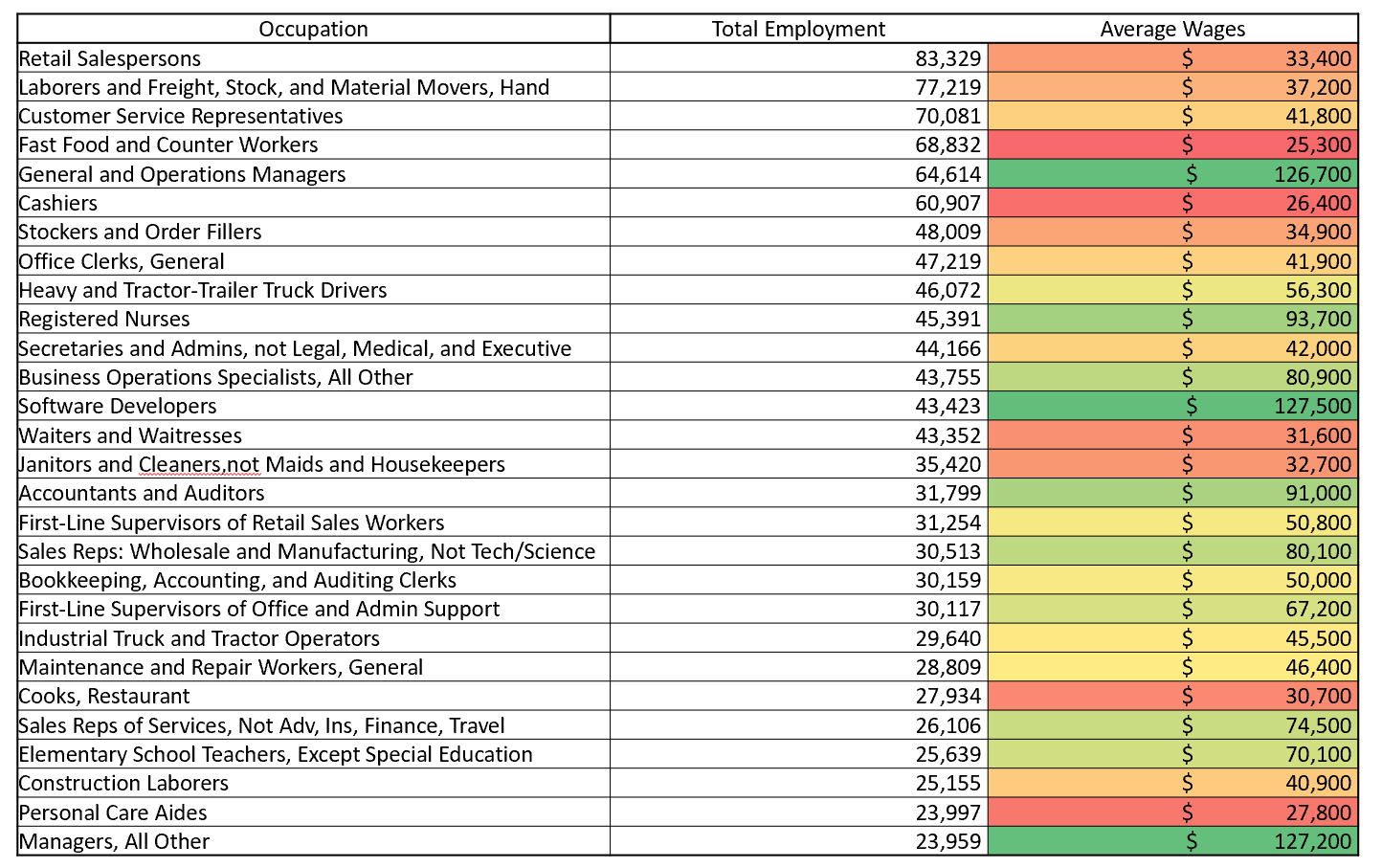
- As has been the case historically, Registered Nurses and Software Developers are the two most in-demand occupations based on job postings from employers.
- In looking at how that demand has changed, occupations that were decimated during the pandemic – fast food workers, laborers, stockers, pre-school teachers – are more in-demand today. Other occupations, such as engineering, are also seeing increased demand in response to federal infrastructure investment initiatives.