Posted on: March 12, 2024
Equal Pay Day (external link) (March 12 of this year) is the date that marks how many additional days into this year women must work in order to equal men’s earnings from last year.[1] How does the pay gap in Metro Atlanta (PDF) (external link) compare to other large metros? Is this pay gap shrinking as female labor force participation rates (external link) grow?[2] Does the pay gap between men and women vary by type of job?
To answer these questions, we turn to 1-year estimates from the American Community Survey (external link), which the Census Bureau has produced for 2005 to 2022.[3] Figure 1 below shows the ratio of median earnings for females vs. males surveyed in 2022, who worked full-time, year-round for the 12 months prior to being surveyed.
Figure 1: Female to Male Median Earnings Ratio in 2022: 20 Largest Metros
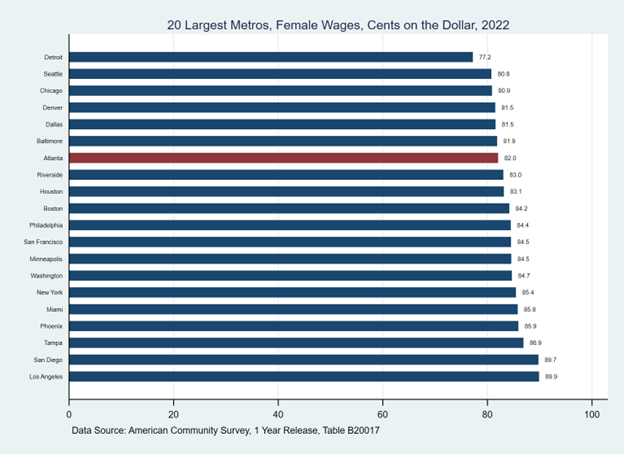
As the above figure 1 shows, women in metro Atlanta earn about 82 cents on the dollar compared with their male counterparts. This places metro Atlanta as the 7th worst among the twenty largest metros (external link) in the United States. Metro Atlanta fares just a slight bit worse than the nationwide average of 82.2 cents. Figure 2 that follows focuses on the same data, only now focusing on change over time for metro Atlanta.
Figure 2: Female to Male Median Earnings Ratio Over Time, Full-Time Employees: Atlanta MSA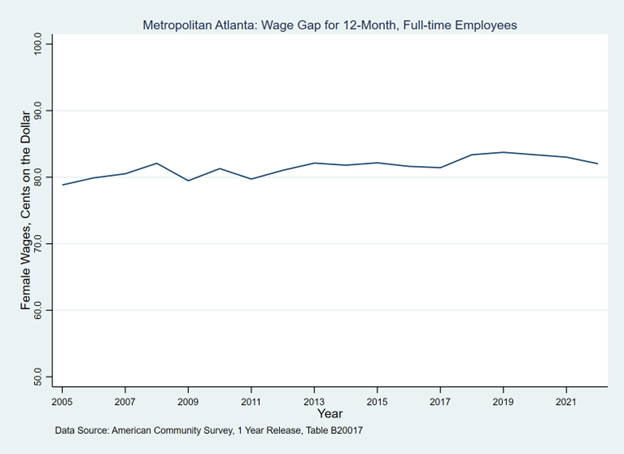
In 2005, Figure 2 above reveals, females earned a median of 78.8 cents per dollar earned by males. By comparison, women earned a median of 82.0 cents on the dollar in 2022– a three-cent reduction in the gap from 21.2 cents to in 2005 18 cents in 2022. Thus, while the gap has narrowed a bit over the last decade and a half, it remains quite wide. Figure 3 below breaks the wage gap down by occupation.
Figure 3: Female to Male Median Earnings Ratio(s) by Occupation: Atlanta MSA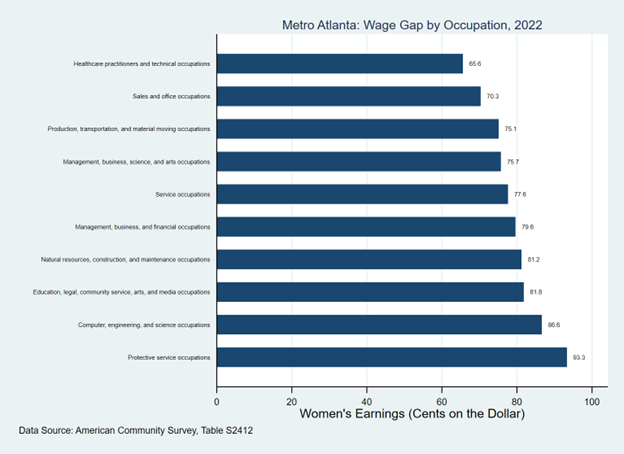
The graph above (Figure 3) shows the wide variation in occupational pay disparities. Disparities are lowest among protective service occupations (where women earn 93.3 cents on the dollar), and highest among health practitioners (women earn only 65.6 cents on the dollar)– a wage gap nearly 28 cents higher in those health occupations. In future blog posts, we will look at some of culprits for the persistence of this wage gap.
Footnotes:
[1] For more information about Equal Pay Day (external link) and other equity pay days, see https://www.aauw.org/resources/article/equal-pay-day-calendar/ (external link) .
[2] For a look at female labor force participation rates (external link) and the narrowing participation rate gap between men and women, see our previous post https://atlantaregional.org/data-diversions/unveiling-the-gap-female-and-male-labor-force-participation.
[3] The American Community Survey (external link) suspended operations for most of 2020 due to the pandemic, so there is no data release for that year.