Posted on: February 17, 2021
Housing instability has been linked with a variety of negative outcomes including but not limited to overall poorer health (external link), diminished educational performance (external link), and employment insecurity (external link). Anticipating that the COVID-related economic slowdown would have on a marked impact on households’ ability to pay rent, the Atlanta Regional Commission, Federal Reserve Bank of Atlanta, and Georgia Tech began working together early on in the pandemic to build a system to track eviction filings and share that information with the public and those best equipped to intervene with legal and financial assistance. In September 2020, the collaborative released the Atlanta Region Eviction Tracker (external link). The tracker is updated weekly, though Fulton County’s census tract level counts have been unavailable since September 2020 due to an omission of certain case details provided via the Fulton Magistrate Court public search site.
Upon its initial release, the tracker revealed a surprisingly low number of filings beginning shortly after the COVID-related lockdown in March 2020. Levels stayed low throughout the most of the summer until a noticeable increase began in August 2020 — as the first CARES Act eviction moratorium expired, along with sunset of the $600 per week unemployment insurance add-on. Despite the subsequent CDC-mandated eviction moratorium, a second round of stimulus checks, and more recently the Biden administration’s extending of the CDC moratorium through March 2021, the tracker continues to show a steady increase in filings across the region in recent months. While filings are not yet to pre-pandemic levels and filings alone do not necessarily portend actual evictions (at the moment), the increase in landlords initiating the legal process to remove tenants does suggest a growing reservoir of missed rent payments and potential displacement on the horizon.
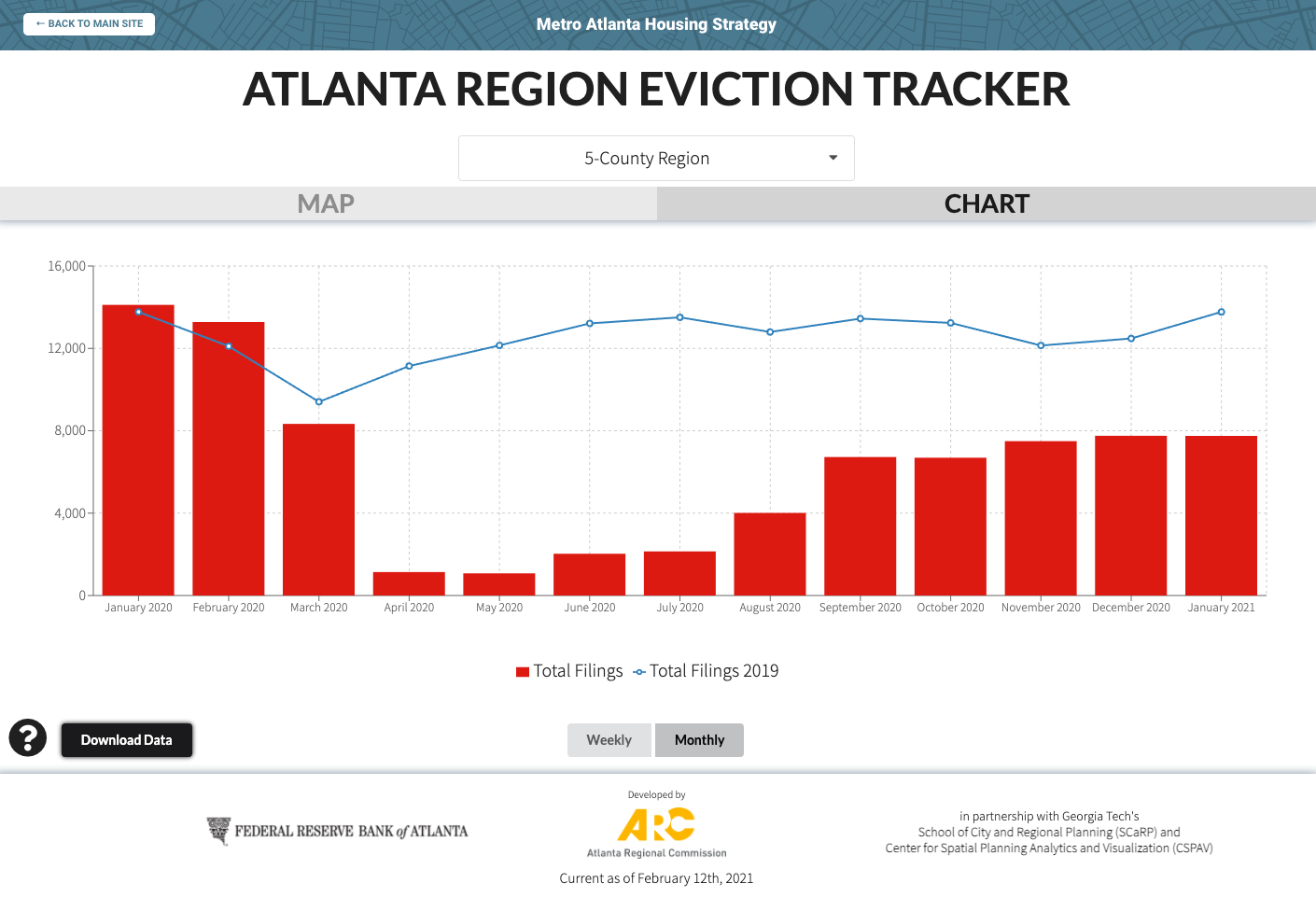
To date, the tracker and researcher collaborative behind it have been able to highlight the ever-growing need, identify hotspots for assistance and outreach (where data is available), and provide detailed information to those working to get legal support and money assistance in a timely manner to those that need it.
Nonetheless without adequate large-scale support, both legal and financial, the threat of an ensuing deluge of evictions is still very real. In his first week in office, Biden took the important step of directing the Treasury Department to make available $25 billion through the Emergency Rental Assistance Program (external link), although because disbursement of the funds will be handled at the state and county levels, the details of how renters will ultimately get access to this money is still largely unknown.
In the meantime, locally…
- DeKalb County – using $21 million allocated in December as part of the second federal stimulus package – is currently accepting applications via its Tenant-Landlord Assistance Coalition (TLAC) (external link) to provide assistance (including rent, rent arrearage, utilities, utility arrearage and other housing costs) for households impacted by the pandemic and earning 80% or less of area median income (based on family composition and size).
- With $18 million from the same pot of money of federal money, Fulton County is expected to begin accepting applications (external link) to a rental assistance program on the first of March.
- Using both CARES Act and philanthropic money, the non-profit Star-C (external link) has been providing assistance throughout the pandemic for residents across the metro region via is Eviction Relief Fund (external link).
- Launched in September 2020, Saving Our Atlanta Region’s Residents (SOARR) (external link) was created by a consortium of non-profits and local advocacy groups to raise and disburse philanthropic money to address the issue region-wide. Application requirements and a portal for accessing this assistance is forthcoming.
- The Atlanta Volunteer Legal Fund (AVLF) (external link) is providing free legal advice and help to those facing eviction in Fulton County. Atlanta Legal Aid (external link) is providing a similar service for residents of Fulton, DeKalb, Gwinnett, Cobb, and Clayton counties.